
As
rebel groups combat the clampdown on anglophone activists, civilians
are being caught in the
crossfire, with reports of many killed and tens
of thousands forced from their homes
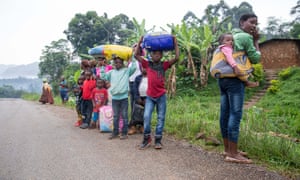
Villagers from Belo, in Cameroon’s north-west, flee the fighting, heading for nearby Bamenda. All photographs by Peter Zongo
An hour and a half’s drive from Bamenda, in Cameroon’s north-west, is
Belo, a village largely abandoned except for a military checkpoint
manned by drunken soldiers.
In the middle of the road is a burnt motorcycle. A little further on,
a corpse is sprawled – someone has tried to cover it with a few
handfuls of grass.
Two girls pass by with bags on their heads filled with dried fish.
“We barely have any food. That’s why we came back to collect the fish,”
they say.
They explain that the corpse belongs to a villager. “There are many
more bodies,” they add. “The soldiers burned part of the village.”
Belo is on the frontline of Cameroon’s simmering conflict
between anglophone and francophone, an increasingly secessionist
struggle that has pitted the French-speaking government in Yaoundé
against the recently emerged Anglophone Ambazonia Defence Forces (ADF)
and other rebel groups. According to the UN, the fighting has forced an
estimated 20,000 Cameroonians to flee to Nigeria.
Many more people forced from their homes remain in the country. On
the main road outside Belo, groups of people are moving, laden with
possessions, whole families leaving with everything they can carry.
“We are on our way to Bamenda,” a woman says. Like all the others, she asks not to be named for fear of reprisal.
“There was a fight between the ADF and the army. Beginning in the
early morning, I heard heavy gunfire. The army attacked the rebels in
the village. The rebels blew up a bridge. So the army got stuck, and the
rebels succeeded in killing the soldiers.
“The army sent reinforcements later in the day, and then they started
taking their revenge on the villagers. They burned the houses, raped
women and executed people at random. Those who had the chance to flee
are hiding in the jungle,” she says. She could not tell how many were
killed. “Many. This is a genocide.”
The matron at the nearby Mbingo Baptist hospital confirms that on the
evening of 5 April “many soldiers” were brought in. About civilian
casualties, however, she says she is unaware.
What happened in Belo is not unique in a conflict that has been rapidly gaining momentum.
Although
French and English are both official languages in the central African
country, English speakers complain of policies they say discriminate
against them, particularly in the education and judicial systems.
Beginning as an anglophone demand for more say in the government of
President Paul Biya, that movement evolved at the end of 2016 into
strikes, demonstrations and an uprising.
Then in 2017 the Cameroon Anglophone Civil Society Consortium began Operation Ghost Town, a call for the shutdown of schools in the English-speaking south-west and north-west provinces.
In response, the government arrested anglophone leaders, blocked the
internet for three months and installed a curfew in a series of
repressive measures that became deadly when, in September of last year,
at least 40 were reportedly killed during massive demonstrations.
That in turn provoked rebellion when in December separatists of the
Ambazonian Defence Forces began attacks on state targets, with Biya
declaring war on the separatists in places like Belo in retaliation.
In the village of Ambo the scene is similar to Belo. Small groups of
soldiers occupy the village centre. The walls of several houses are
marked by bullet holes and arson attacks.
An old man is standing in his door. “I could not flee, because my leg
is crippled. My grandchild had to stay with me – both her parents are
dead. For weeks now, we have survived on bananas.”
Another man joins the conversation. His knee is suppurating where he
was beaten and on his back, a slowly healing scar shows where he was
struck with a machete. “The soldiers nearly got me,” he mutters.
He points to a nearby house. “An old woman was shot there. The
soldiers killed her in her own house. I also saw two girls hit by
bullets in their shoulder.”
And while the fighting in Belo occurred last month, the violence is continuing.
Near the village of Widikum, machine guns rattle. A roadblock – one
of the many that are situated every 10km or so – has been attacked by
rebels. When travellers are finally permitted to pass, a house is
burning further down the road.
Lucas Cho Ayaba is commander in exile of the Ambazonia Governing
Council, of which the Ambazonia Defence Forces are the military arm. He
sees the government in Yaoundé as an occupying force.
“60% of the GDP of Cameroon
is earned in Ambazonia. Oil and wood are exploited by foreign
companies, but the profits go to Yaoundé. On the other hand there is
allegedly no money to provide for English-speaking teachers,” Ayaba says
in an interview by phone.
“Our first aim is to make Ambazonia ungovernable. We must try to
raise the cost of the occupation to higher than the profits they get
here.”
His
comments explain the actions of the ADF. Lorries transporting huge logs
are torched by the rebels. In the village of Batibo a local authority
building has been destroyed. Civil servants have been kidnapped.
“We cannot stand idly by,” Ayaba adds. “Peaceful protests and civil
disobedience in the ghost towns simply do not have any effect against
the repression of Yaoundé.”
Ayaba also denies claims that Nigeria is backing the ADF, and that
there are Nigerians among their forces. “I do not know of any Nigerians
in ADF. Of course we have training camps, but they are located in
villages of Ambazonia not in Nigeria.”
Despite this, say locals in Bamenda, support for the Amba-boys, as the ADF are locally known, is not always voluntary.
“Those who don’t support the guerrillas with food, petrol or weapons
is put away as a traitor,” says the man attacked by the machete.
Since you’re here …
… we have a small favour to ask. More people are
reading the Guardian than ever but advertising revenues across the media
are falling fast. And unlike many news organisations, we haven’t put up
a paywall – we want to keep our journalism as open as we can. So you
can see why we need to ask for your help. The Guardian’s independent,
investigative journalism takes a lot of time, money and hard work to
produce. But we do it because we believe our perspective matters –
because it might well be your perspective, too.
I appreciate there not being a paywall: it is more democratic for the media to be available for all and not a commodity to be purchased by a few. I’m happy to make a contribution so others with less means still have access to information. Thomasine, Sweden
Thank you to the many people who have already
supported us financially – your contribution is what makes stories like
you’ve just read possible. We increasingly need our readers to fund our
work so that we can continue holding power to account and producing
fearless journalism.
Source:theguardian.com
S


